Junk Display Font for Handmade Labels & Printables
As someone who hand-presses candle labels, cuts vinyl stickers for local boutiques, and designs printable wedding suites for Etsy buyers, I’ve learned that the right display font doesn’t just look good—it builds trust, tells a story, and makes your product feel *intentional*. That’s why Junk has become my go-to display font for projects where personality meets practicality.
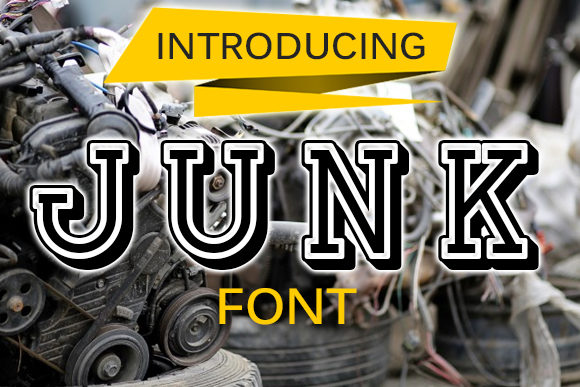
Junk isn’t loud for the sake of it. It’s bold, slightly quirky, and full of quiet confidence—think clean geometric structure with subtle rounded terminals and balanced spacing. It leans modern but avoids cold minimalism; there’s warmth in its proportions and clarity in its letterforms. Unlike many display fonts that sacrifice legibility at small sizes, Junk holds up beautifully on ¾-inch sticker labels, engraved wooden tags, and even sublimation-printed tote bags.
I use Junk most often for short, high-impact text: shop names on apothecary-style candle jars, “Handmade with Love” on kraft paper gift tags, “Welcome” on farmhouse-style welcome boards, or “Just Married” on foil-stamped invitation envelopes. Its strong x-height and open counters mean it cuts cleanly on Cricut Explore and Silhouette Cameo machines—even at 14–16pt on delicate vinyl. For digital printables like planner covers or quote posters, I scale it to 36–72pt and let its rhythm do the work.
What makes Junk especially valuable for craft sellers is how it bridges aesthetic and function. On a holiday ornament label, it reads clearly at 8mm tall. On a 24x36" printable wall art piece, it commands attention without overwhelming. And because it’s designed as a true display font—not a stretched sans serif or overworked script—it feels intentional, not gimmicky. Customers notice that difference. They associate that polish with quality craftsmanship, whether you’re selling physical goods or digital downloads.
Here’s where Junk shines in real projects:
- Candle & soap labels: Paired with a soft serif (like Playfair Display) for ingredients or scent notes, Junk adds instant character to minimalist packaging.
- Wedding stationery: Use it for “Mr. & Mrs.” on signage or “RSVP” on reply cards—its friendly weight feels personal but never childish.
- SVG cut files: Clean outlines and consistent stroke width make it ideal for layered vinyl decals, iron-on transfers, and laser-cut wood signs.
- Seasonal printables: It works year-round—“Spooky Season” on Halloween SVGs, “Cozy Vibes Only” on winter planner pages, “Sunshine & Saltwater” on summer beach tags.
- Boutique product tags: Small-batch makers love how Junk elevates simple kraft cardstock—especially when paired with a fine-line handwritten font for names or dates.
Readability matters—especially when your buyer prints at home or cuts at 120 DPI. Junk renders crisply at all standard sizes. I test every font on actual sticker paper before listing a new printable, and Junk consistently passes: no fuzzy edges, no collapsed counters on “e” or “a”, and no awkward spacing between “T” and “o” in common words like “To” or “Top”. Bonus: it includes stylistic alternates (like a swash capital “J”) and ligatures that add charm without sacrificing consistency across your brand.
Font pairing is where Junk really flexes its versatility. Try it with:
- A relaxed handwritten font (like Brittany or Quicksand) for contrast—perfect for greeting cards where Junk handles the headline and the script adds warmth in the body.
- A clean, neutral sans serif (like Inter or Manrope) for product labels or packaging—Junk grabs attention, the sans serif delivers clarity.
- A gentle serif (like Lora or PT Serif) for wedding or boutique branding—Junk brings energy, the serif grounds it in elegance.
Junk comes in OTF and TTF formats, fully compatible with Adobe Creative Suite, Cricut Design Space, Silhouette Studio, Canva, and Affinity apps. It supports Latin-based languages and includes uppercase, lowercase, numerals, punctuation, and multilingual accents—so if you sell globally or design bilingual baby shower invites, you’re covered. No need to hunt for workarounds or substitute glyphs.
One thing I always double-check before launching any product? Licensing. Junk is a commercial font, meaning you’re fully cleared to use it in physical products (stickers, mugs, apparel), digital downloads (PDF planners, SVG bundles), client work (custom invitation suites), and even merchandise sold under your own brand. Just keep your license active—you don’t need extended rights for standard craft use, but always verify the included license terms before bundling into editable templates.
If you’ve ever hesitated to use a display font because it felt too trendy, too fragile, or too hard to pair, give Junk a try. It’s got the presence to stand alone, the flexibility to complement other typefaces, and the reliability to perform across mediums—from inkjet-printed thank-you cards to heat-pressed t-shirts. It doesn’t shout “look at me!”—it says, “This was made with care.” And in handmade business, that’s exactly the message your customers want to read.